

More Connected, Less Connected? Yet close to no one. On World Mental Health Day,10th October, Suburb posed a poignant question to four leading voices in young people, education, psychology and inner wellbeing:
What is the most significant mental health challenge facing India today, and what can we do strategically about it?
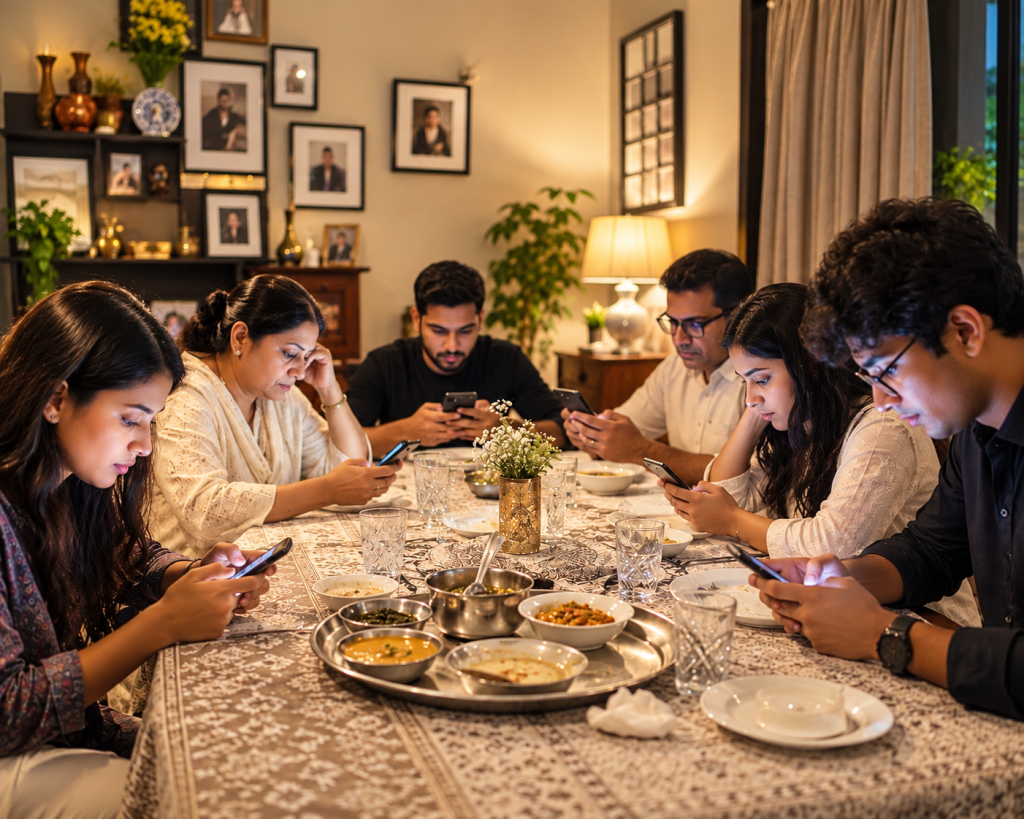
We wake up to messages, scroll through other people’s lives before we have lived ours, check notifications between conversations, and reach for our phones even when someone is sitting right beside us. We have become so restless and want a distraction.
As Aditi Misra, senior academician and Director Principal at DPS Sec 45, puts it, I believe devices, social media, and over-involvement in the digital space have completely isolated people from each other. Real relationships and real conversations don’t seem to exist. Obviously, anyone grappling with loneliness or anxiety becomes more caught up in their problem because there is no one to talk to. Not all problems have solutions … but sharing problems does lighten the heart. Unfortunately, the issue is spiralling. We need families that see and acknowledge this extremity; listen without immediately judging or desiring a temporary quick fix.”
Rohini Singh, spiritual healer, EFT Master trainer and author, looks at the crisis arising from addiction. “Addiction to our devices and the consumption of social media. What makes it more dangerous is that it remains unrecognised. Lost in our phones and engaged in digital conversations. The internet has wiped out the inner net. Brain fog is becoming the new normal. Relationships are deteriorating because we have little energy or time for intimacy and depth. We have become dependent on “likes” from digital “friends.” Panic attacks are becoming a common affliction.”
Notably, all four experts from diverse fields align in their beliefs.
Dr Roma Kumar, senior consultant psychologist, Sir Gangaram Hospital, says, “The gap between the need for mental healthcare and access to timely, appropriate support is widening. Stigma, limited awareness, shortage of trained professionals, and delayed help-seeking continue to be major barriers.”
Inderbir Thussu, Head of School, Kunskapsskolan Gurgaon, and a Thought Leader, believes that anxiety and depression are the most prevalent challenges. “It is profoundly difficult to comprehend what these children endure; they often mask their emotions and struggle to articulate their feelings. The resulting meltdowns are emotionally draining, and recovery demands unwavering support. A robust support system consisting of parents, counsellors, and teachers is imperative.”
Rohini Singh candidly speaks: “First, become aware of the problem. Set aside time each day to be “free of your phone” and spend intentional time with yourself and loved ones. Learn the value of simply being.”
For many young adults, the screen has become a companion, confidante, entertainer, therapist and sometimes even a measure of self-worth. What began as social connection has, for many, morphed into comparison, validation-seeking, anxiety and an alarming form of social toxicity.
Perhaps the greatest challenge is that, while conversations about mental health have become more visible, acceptance has not necessarily kept pace, opines Kumar. In India, psychological distress can still be misunderstood, minimised or hidden behind labels such as weakness, adjustment, overthinking or just a phase. Early intervention, whether in school, at home or at work, requires compassionate handholding and attention to reclaim the lost art of real connection.
“When was the last time you were truly there for someone and truly present for yourselves?”
Discover more from Suburb Life
Subscribe to get the latest posts sent to your email.