

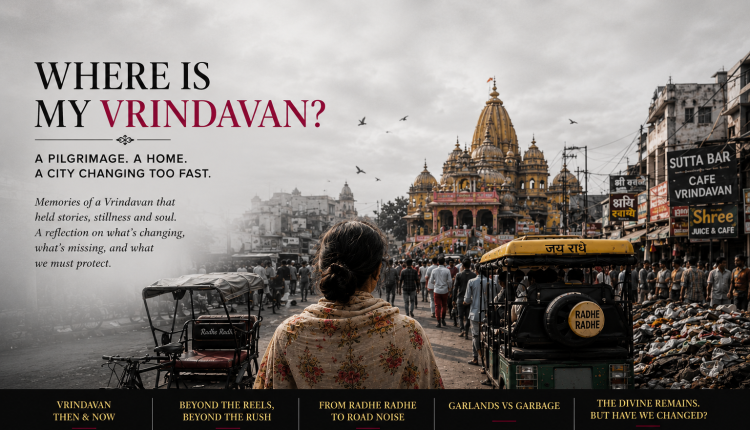
For over two decades, Vrindavan has been more than a destination for me. It has been my anchor. The whispering sound of Radhe Radhe is an enigma in itself, which dissolves all noise, drawing me away from the noise within and outside.
Many years ago, someone told me, “If you come to Vrindavan with even the slightest intention of bhakti, rest assured, Vrindavan will hold on to you like glue.” I didn’t understand it then. Today, I have lived that truth.
Every time life feels unsettled, every time my inner compass begins to waver, or when gratitude overflows and seeks expression, something quietly falls into place. Before I know it, I’m behind the steering wheel, driving towards Vrindavan. It’s usually not a pre-planned trip; it’s a pilgrimage of the heart.
The familiar roads, the roadside dhabas, the fragrance of flowers, the chants of Radhe Radhe, the winding lanes, the temple bells, the conversations with strangers who somehow never remained strangers- everything has always felt like coming home to familiarity.
But of late, every visit leaves me with a strange ache.
A city of faith is buckling under the pressure of viral tourism, rapid urbanisation, and an ever-growing mountain of garbage. Something intangible has been lost in the city. When millions arrive seeking Krishna, few stop to ask what they are leaving behind.
The humble cycle rickshaws, once an inseparable part of the town’s character, have almost disappeared. They have been replaced by arrogant e-rickshaw drivers who lack the basic premise of the revered city. I don’t remember the old rickshaw pullers honking impatiently. Their gentle way of asking for space was simply, “Radhe Radhe.” Those rides often became storytelling sessions. They introduced us to hidden temples, forgotten legends, local customs and the soul of the town itself.
Sutta bars, flashy cafés and commercial corners that could belong to any city are slowly eroding the unique cultural texture of Vrindavan. Not every modern addition is unwelcome, but some feel completely disconnected from the spirit of the place.
The sweetness of Braj Bhasha struggles against the high-pitched chaos of traffic and people. The roads are rougher, the dumps larger, and the pauses fewer.
Even darshan has changed.
Yes, it may have always been crowded and somewhat chaotic, but there was once a strange serenity amidst the disorder. Today, walking to Banke Bihari, Rang ji or Gopeshwar feels like navigating a relentless tide of people. The pushing, pulling, and impatience make one wonder: have we forgotten why we came? The new tourist spots (read as temples) seem like business in progress.
Then there is the growing tribe of content creators.
The desire to capture every moment often seems greater than the desire to experience it. Perhaps the most ironic sight is watching someone stand with their back to the deity, camera focused on their own face, while the divine becomes merely a backdrop. Somewhere between content and contemplation, bhav has quietly slipped away.
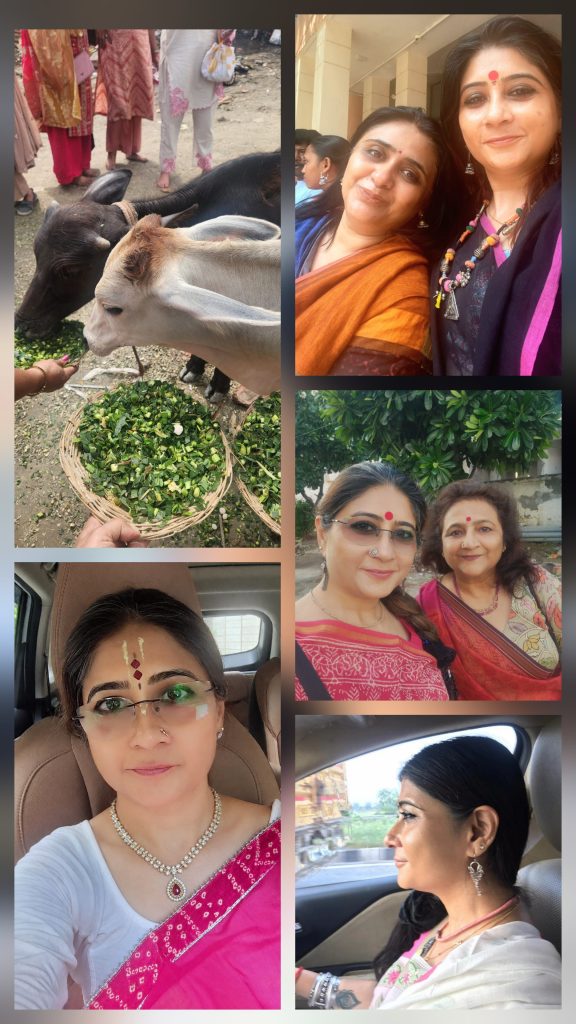
I miss the Vrindavan where time slowed down.
For years I would go to the city to disappear among the devotees, moving around in a Gopi dress with Majeera and Tilak. It was rejuvenating to sit under a tree, sip Chai at a roadside stall, strike up a conversation with a local, and return with stories no guidebook could ever tell. Vrindavan will always remain sacred. For me, it nourishes my inner sanctuary.
Its divinity does not diminish because of human behaviour. But as its popularity grows, I wonder if we, as visitors, are forgetting that sacred places are not just meant to be visited; they are meant to be felt.
Perhaps the real question is not just, “Where is my Vrindavan?”
Perhaps it is, “Are we still arriving with the same bhav that once made Vrindavan feel like home?”
When devotion becomes a trend, even the holy city begins to lose its breath. God willing, I’ll keep visiting, for it still calls.
Discover more from Suburb Life
Subscribe to get the latest posts sent to your email.

straight from the heart story , anybody who’s been visiting the place for the past couple of years can relate to the same … we all must understand the need to preserve the sanctity of such places while moving forward to promote religious tourism !!!